
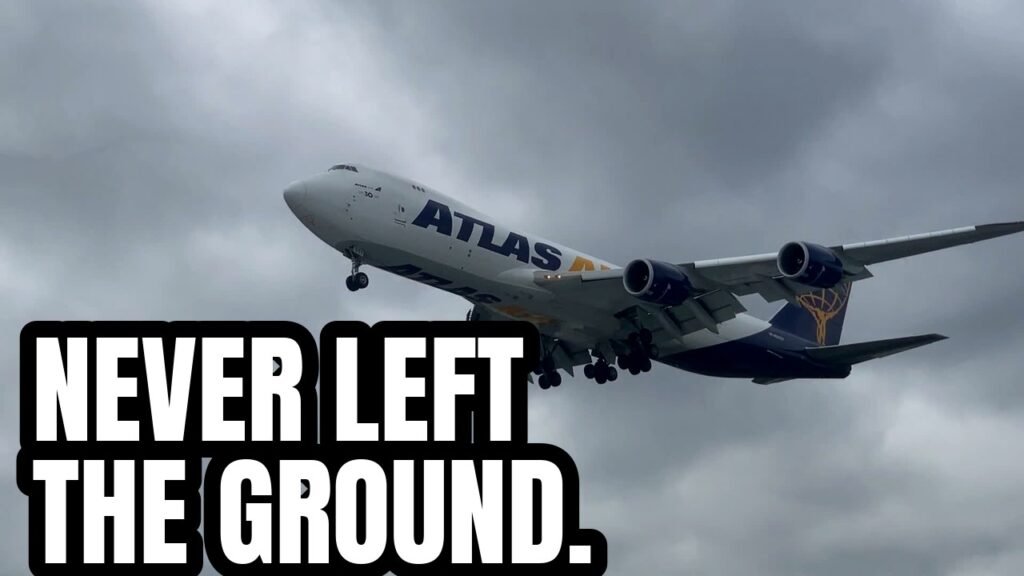
The Worst Crash That Never Left the Ground
583
Lives lost — deadliest in aviation history
61
Survivors — all from the Pan Am jet
2 × 747
KLM 4805 · Pan Am 1736
3 sec
Of radio static that hid two warnings
How do two of the biggest planes ever built collide on a runway — at an airport neither one was supposed to be at? On the 27th of March 1977, 583 people died in the worst aviation accident in history — because of a bomb, a fog bank, and three seconds of radio static.
Every disaster is a chain. We publish every link.
No single cause killed 583 people at Tenerife. Eight separate links had to hold at once — break any one of them and the day ends differently. Tap a link to jump into the full breakdown inside the article.
1. The bomb at Gran Canaria
A bomb planted by the Canary Islands Independence Movement (MPAIAC) exploded in Gran Canaria’s terminal at 13:15, injuring eight people. The threat of a second bomb closed the airport. The Pan Am crew said they would prefer to hold in the air — they had fuel for two more hours — but were ordered to divert. Without this link, neither aircraft is ever at Los Rodeos.
Source: Wikipedia; FAA Lessons Learned
2. A small airport, overwhelmed
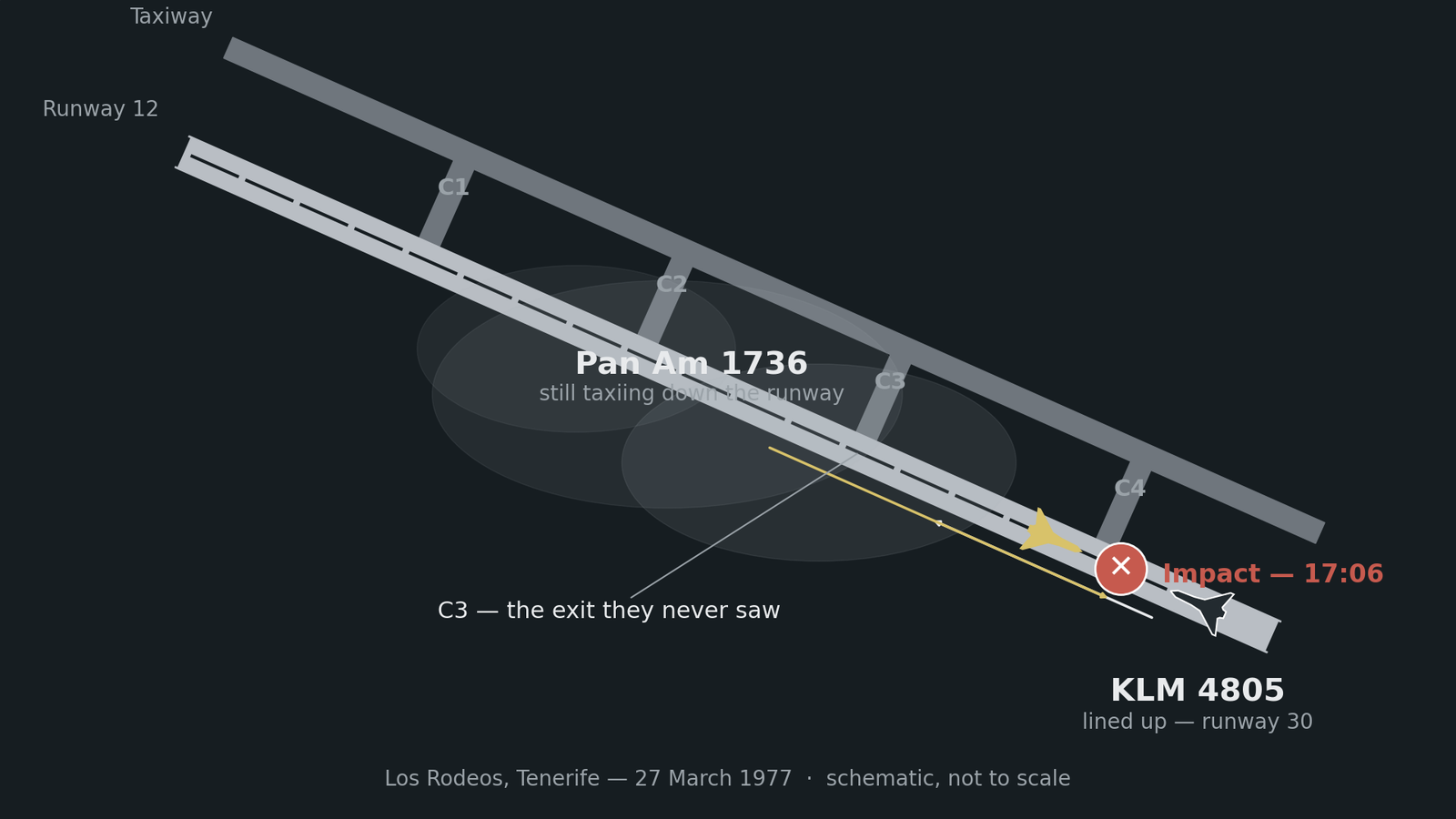
Los Rodeos had a single runway and a single parallel taxiway joined by four short links. Five large airliners were diverted there. Parked aircraft filled the taxiway entirely, so departing jets had to backtrack along the runway itself — the same runway other aircraft were still taxiing on. While KLM refuelled, the gap Pan Am had to squeeze past the parked jets was 3.7 metres.
Source: Wikipedia, citing the official report
3. The refuelling decision
The KLM captain chose to take a full fuel load at Los Rodeos instead of Gran Canaria, apparently to save time later. Refuelling took about 35 minutes — time in which the fog settled in. The extra weight (the official report records more than 45 tonnes) lengthened the takeoff run the jet would need, and greatly increased the fire after impact.
Source: FAA Lessons Learned; Wikipedia
4. Duty-time pressure
Dutch law had recently tightened maximum on-duty hours for aircrew. Investigators concluded Captain van Zanten wanted to depart as soon as possible to stay within KLM’s duty-time regulations, and before the weather deteriorated further. He had also spent the previous twelve weeks as a simulator instructor rather than flying regular routes.
Source: Official report, via Wikipedia
5. The fog
Los Rodeos sits at 633 m, exactly where coastal cloud touches the ground. Drifting cloud banks gave wildly varying visibility: about 500 m as Pan Am entered the runway, under 100 m shortly after. At the KLM end it was comparatively clear, with the next bank 900 m away moving toward them. The tower could not see the runway, and the airport had no ground radar — position knowledge came only from radio reports.
Source: Official report & ALPA study, via Wikipedia
6. The missed exit
Pan Am was told to leave the runway at the third exit, C3. The exits were unmarked and unsigned. The crew found C1 and C2 but never sighted C3. That exit required a 148° turn — and the ALPA study concluded the second 148° turn at the end of C3 was ‘a practical impossibility’. First Officer Bragg later said he believed the controllers meant the third exit after the first one they passed — which would have been C4, where the collision happened.
Source: Official report & ALPA study, via Wikipedia
7. The words
The tower gave KLM a route clearance — where to fly after takeoff — but used the word ‘takeoff’ inside it. The first officer’s readback ended ‘We are now at take-off’ (or ‘taking off’ — the record never settled which). The captain interrupted with ‘We’re going’ and released the brakes at 17:06:11. A route clearance is not a takeoff clearance; that distinction, blurred for seconds, is the hinge of the whole accident.
Source: CVR transcript, CIAIAC report
8. Three seconds of static
At 17:06:18–20 the tower said ‘OK… stand by for takeoff, I will call you’ at the exact moment Pan Am transmitted ‘…we’re still taxiing down the runway, the Clipper one seven three six.’ The overlapping signals produced a heterodyne squeal of about 3 seconds (3.74 s in reconstructions) in the KLM cockpit. Neither warning was heard. At 17:06:32 the flight engineer asked ‘Is he not clear, that Pan American?’ — and accepted the captain’s emphatic ‘Oh yes.’
Source: CVR transcript; AeroCorner reconstruction
Episodes & articles
One article per episode — plus the explainers that come out of the research. Newest first.
The 8,485 People Who Sued America
The Steam Mistake
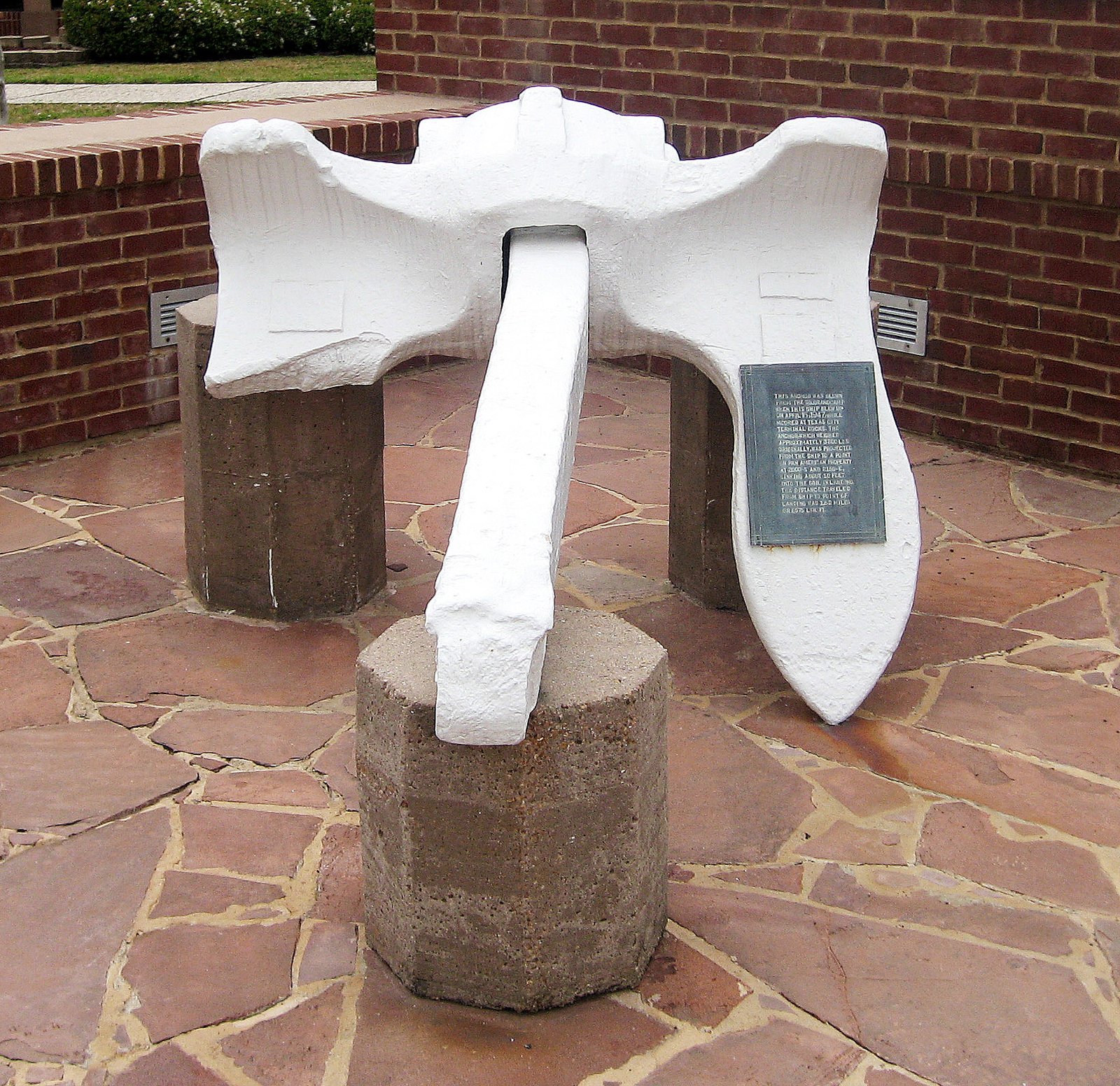
The Anchor That Flew a Mile and a Half
The Question Asked Once: How Tenerife Rebuilt the Cockpit
“Departure”, Not “Takeoff”: The Words Tenerife Changed
The Worst Crash That Never Left the Ground
Episode 02 — Texas City, 16 April 1947
The Anchor That Flew a Mile and a Half
At least 581 lost
2 ships, 16 hours apart
1.62 miles — the anchor’s flight
73 years later, it happened again
How does a shipload of fertilizer flatten a city?
STATUS · LIVE