
583 lost
61 survivors
2 × 747
3 seconds of static
How do two of the biggest planes ever built collide on a runway — at an airport neither one was supposed to be at? On the 27th of March 1977, 583 people died in the worst aviation accident in history — because of a bomb, a fog bank, and three seconds of radio static.
The diversion
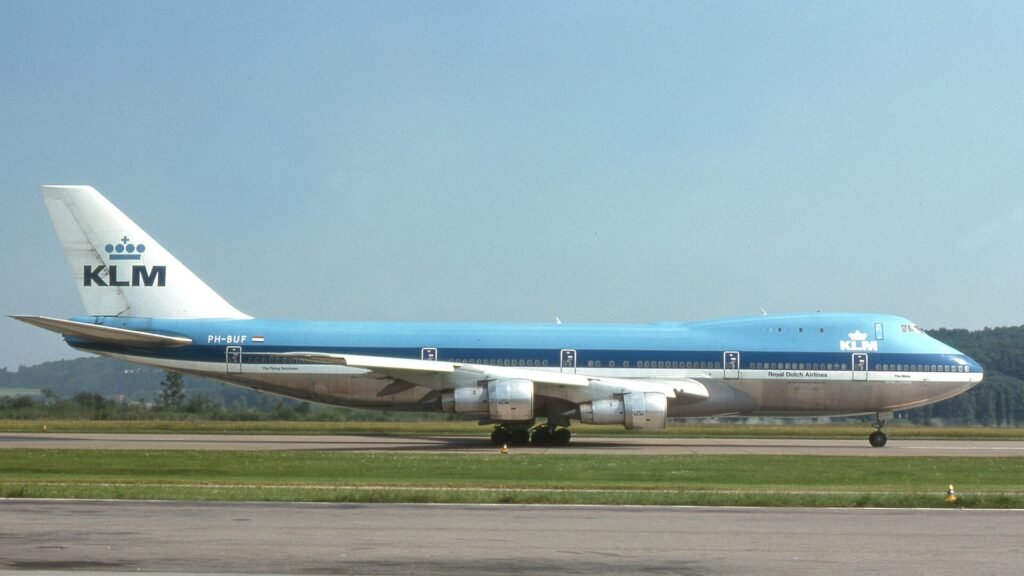
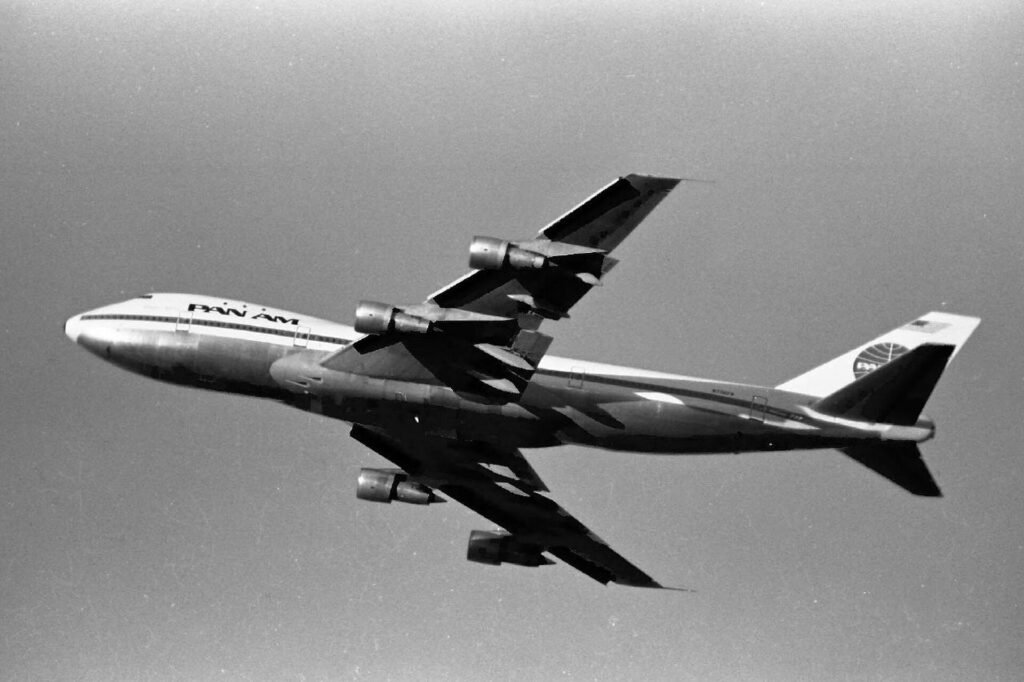
That Sunday morning, two Boeing 747s were heading for Gran Canaria: KLM Flight 4805 from Amsterdam, 248 people on board, mostly Dutch holidaymakers; Pan Am Flight 1736 from Los Angeles via New York, 396 people, mostly American retirees. At 1:15 that afternoon, a bomb went off in Gran Canaria’s terminal. Eight people were hurt, a second was threatened, and the airport closed. The Pan Am crew would rather have stayed airborne — they were ordered down. Both landed at Los Rodeos, Tenerife — one runway, one taxiway, five diverted jets filling the taxiway. The KLM captain then made a decision that cost 35 minutes: a full fuel load, more than 45 tonnes, taken on there instead of at Gran Canaria. One KLM passenger never got back on. Robina van Lanschot, a tour guide who lived on Tenerife, saw no point in flying to Gran Canaria and straight back — and she was the only person from that flight who survived.
The runway
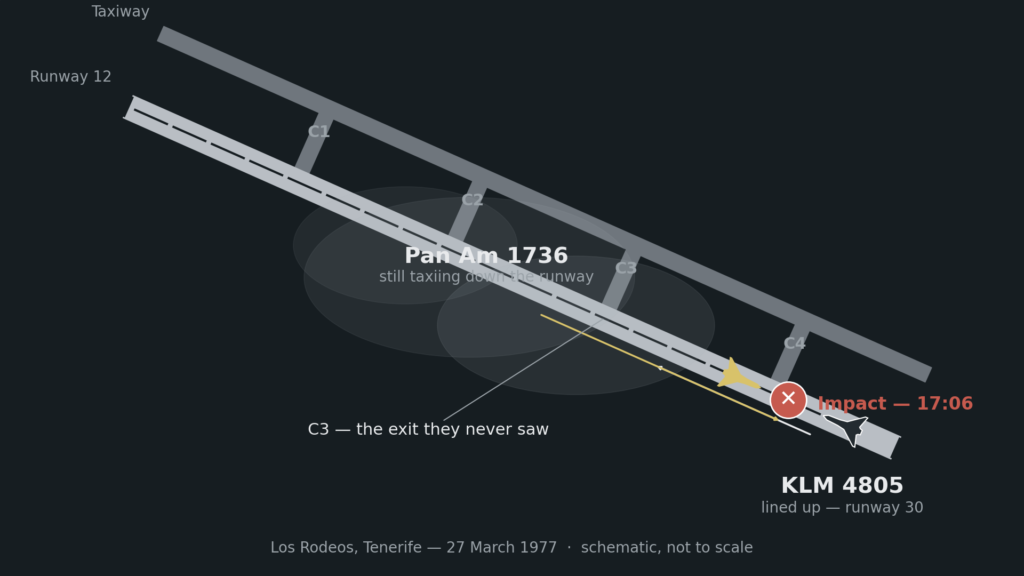
When Gran Canaria reopened, it was time to leave — but the taxiway was still blocked. The Pan Am couldn’t reach the runway: the gap between the two parked 747s was less than four metres. Both planes then had to taxi down the runway itself to turn around. The tower told the Pan Am to leave at the third exit. The exits were unmarked, and the fog was closing in. The Pan Am crew found the first two, but never saw the third — a 148-degree turn investigators later called a practical impossibility. By then the Pan Am’s visibility was under 100 metres, and the tower couldn’t see the runway at all — no ground radar — so controllers could only track the planes by what the crews told them.
The words
At the far end, the KLM turned and lined up under Captain Jacob Veldhuyzen van Zanten, KLM’s chief flight instructor. He opened the throttles — and his first officer stopped him. ‘Wait a minute, we don’t have an ATC clearance.’ ‘No, I know that. Go ahead, ask.’ The first officer radioed the tower: ready for takeoff, waiting for clearance. What came back was a route clearance — where to fly after takeoff. But the controller used the word ‘takeoff’ inside it. The first officer read it back, ending with the words: ‘We are now at takeoff.’ Those words can mean two things: we are taking off, or we are waiting at the takeoff position. The record still doesn’t settle which. The tower answered: ‘OK… stand by for takeoff, I will call you.’ At the very same instant, the Pan Am radioed: ‘We’re still taxiing down the runway.’ Both spoke at once, and the two signals collided into a three-second squeal — the KLM crew heard neither warning. The tower then asked the Pan Am to report when the runway was clear. In the KLM cockpit, the flight engineer asked: ‘Is he not clear, that Pan American?’ The captain answered: ‘Oh yes.’ And the throttles stayed open.
From the public cockpit voice recorder and tower transcripts, as published in the official report. No audio of the recordings is publicly available — this is the transcript only.
| 17:05:41 | KLM First Officer in the cockpit | “Wait a minute, we don’t have an ATC clearance.” The captain had advanced the throttles. Captain van Zanten replies: “No, I know that. Go ahead, ask.” |
| 17:05:44 | KLM First Officer to the tower | “The KLM four eight zero five is now ready for take-off and we are waiting for our ATC clearance.” |
| 17:05:53 | Tenerife Tower to KLM | Route clearance: cleared to the Papa beacon, climb to flight level nine zero, right turn after takeoff… A route clearance — where to fly once airborne. NOT a takeoff clearance. Note the word “takeoff” inside it. The tower also used the wrong call sign (“KLM eight seven zero five”). |
| 17:06:09 | KLM First Officer readback | “…We are now at take-off.” Or “we are taking off” — the record does not settle which phrase was used. The captain interrupts the readback: “We’re going.” Brakes released 17:06:11. |
| 17:06:18 | Tower + Pan Am same instant | Tower: “OK… stand by for takeoff, I will call you.” — Pan Am: “And we’re still taxiing down the runway, the Clipper one seven three six.” Transmitted simultaneously. In the KLM cockpit: ~3 seconds of heterodyne squeal. Neither message heard. |
| 17:06:25 | Tower → Pan Am | “Report the runway clear.” — Pan Am: “OK, we’ll report when we’re clear.” Heard in the KLM cockpit — the exchange the flight engineer was listening to when he asked his question. |
| 17:06:32 | KLM Flight Engineer in the cockpit | “Is he not clear, that Pan American?” Captain: “Oh yes.” (Emphatic.) The takeoff continues. The first officer, who had challenged once, does not challenge again. |
| 17:06:40 | Pan Am Captain sees the lights | “Get off! Get off! Get off!” Landing lights through the fog at ~700 m. Captain Grubbs applies full power and turns hard left toward the grass. First Officer Bragg is shouting the warning. |
| 17:06:43 | KLM First Officer | “V-1.” Decision speed — beyond this point, the takeoff cannot be safely aborted. Rotation begins a second later, early, trying to climb over the Pan Am. |
| 17:06:49.7 | Impact both recorders | Both cockpit voice recorders capture the sound of the collision. The KLM’s nose gear cleared the Pan Am. Its engines, lower fuselage and main gear did not. |
The collision in the airwaves: at 17:06:18 the tower’s “stand by for takeoff” and Pan Am’s “we’re still taxiing down the runway” were transmitted at the same instant, on the same frequency. In the KLM cockpit they merged into a heterodyne squeal lasting about three seconds — reconstructions measured 3.74 seconds. The KLM crew heard neither warning clearly. Either one, heard in time, would likely have stopped the takeoff.
The collision
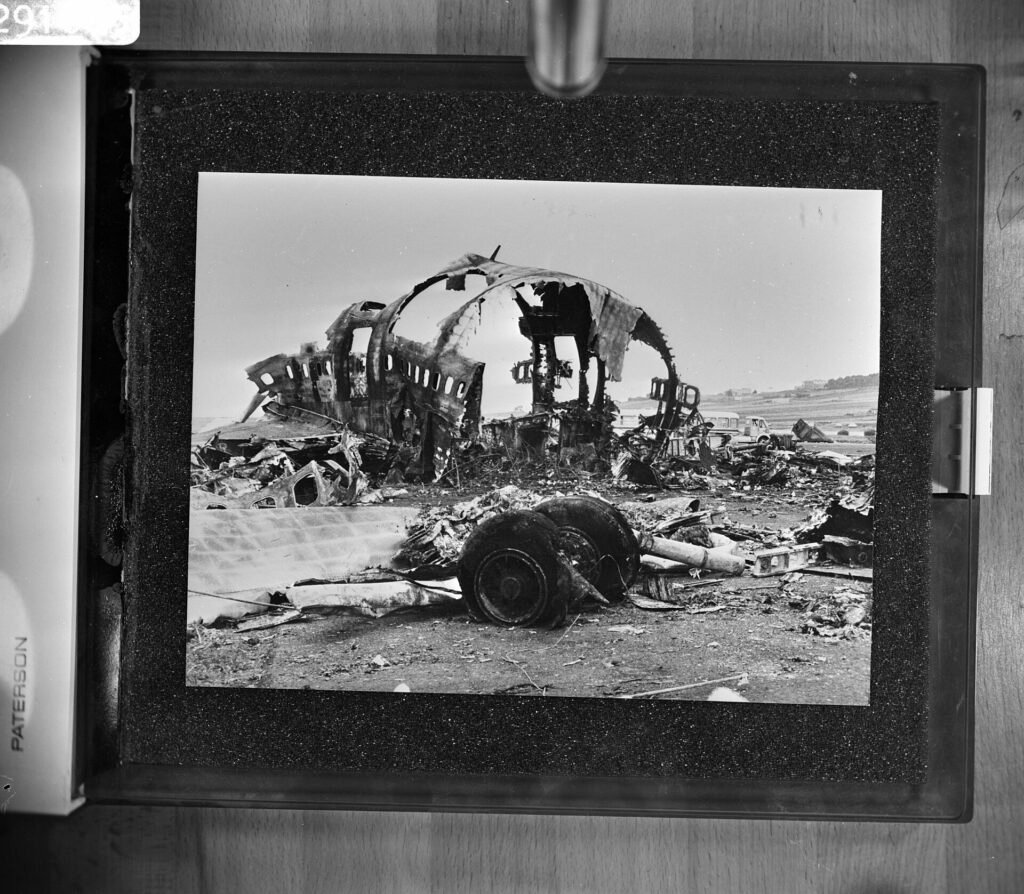
At 17:06, the Pan Am captain saw the KLM’s landing lights through the fog, 700 metres away. ‘Get off! Get off! Get off!’ He threw the throttles forward and turned hard left, toward the grass. The KLM was past decision speed — too fast to stop. The pilots pulled the nose up early, trying to lift over the Pan Am. The tail scraped the runway for 22 metres, and the plane got airborne — just barely — its engines and landing gear tearing through the top of the Pan Am’s fuselage. It stayed airborne for seconds, an engine tore off, and it stalled, rolled, and came down 150 metres past the impact, sliding another 300 — and the fuel ignited. 583 people were dead. All 248 on the KLM. 335 of the 396 on the Pan Am. 61 people survived — all on the Pan Am, all in the front of the plane. Most climbed out onto the left wing and dropped to the ground.
The chain — eight links
1. The bomb at Gran Canaria
A bomb planted by the Canary Islands Independence Movement (MPAIAC) exploded in Gran Canaria’s terminal at 13:15, injuring eight people. The threat of a second bomb closed the airport. The Pan Am crew said they would prefer to hold in the air — they had fuel for two more hours — but were ordered to divert. Without this link, neither aircraft is ever at Los Rodeos.
Source: Wikipedia; FAA Lessons Learned
2. A small airport, overwhelmed
Los Rodeos had a single runway and a single parallel taxiway joined by four short links. Five large airliners were diverted there. Parked aircraft filled the taxiway entirely, so departing jets had to backtrack along the runway itself — the same runway other aircraft were still taxiing on. While KLM refuelled, the gap Pan Am had to squeeze past the parked jets was 3.7 metres.
Source: Wikipedia, citing the official report
3. The refuelling decision
The KLM captain chose to take a full fuel load at Los Rodeos instead of Gran Canaria, apparently to save time later. Refuelling took about 35 minutes — time in which the fog settled in. The extra weight (the official report records more than 45 tonnes) lengthened the takeoff run the jet would need, and greatly increased the fire after impact.
Source: FAA Lessons Learned; Wikipedia
4. Duty-time pressure
Dutch law had recently tightened maximum on-duty hours for aircrew. Investigators concluded Captain van Zanten wanted to depart as soon as possible to stay within KLM’s duty-time regulations, and before the weather deteriorated further. He had also spent the previous twelve weeks as a simulator instructor rather than flying regular routes.
Source: Official report, via Wikipedia
5. The fog
Los Rodeos sits at 633 m, exactly where coastal cloud touches the ground. Drifting cloud banks gave wildly varying visibility: about 500 m as Pan Am entered the runway, under 100 m shortly after. At the KLM end it was comparatively clear, with the next bank 900 m away moving toward them. The tower could not see the runway, and the airport had no ground radar — position knowledge came only from radio reports.
Source: Official report & ALPA study, via Wikipedia
6. The missed exit
Pan Am was told to leave the runway at the third exit, C3. The exits were unmarked and unsigned. The crew found C1 and C2 but never sighted C3. That exit required a 148° turn — and the ALPA study concluded the second 148° turn at the end of C3 was ‘a practical impossibility’. First Officer Bragg later said he believed the controllers meant the third exit after the first one they passed — which would have been C4, where the collision happened.
Source: Official report & ALPA study, via Wikipedia
7. The words
The tower gave KLM a route clearance — where to fly after takeoff — but used the word ‘takeoff’ inside it. The first officer’s readback ended ‘We are now at take-off’ (or ‘taking off’ — the record never settled which). The captain interrupted with ‘We’re going’ and released the brakes at 17:06:11. A route clearance is not a takeoff clearance; that distinction, blurred for seconds, is the hinge of the whole accident.
Source: CVR transcript, CIAIAC report
8. Three seconds of static
At 17:06:18–20 the tower said ‘OK… stand by for takeoff, I will call you’ at the exact moment Pan Am transmitted ‘…we’re still taxiing down the runway, the Clipper one seven three six.’ The overlapping signals produced a heterodyne squeal of about 3 seconds (3.74 s in reconstructions) in the KLM cockpit. Neither warning was heard. At 17:06:32 the flight engineer asked ‘Is he not clear, that Pan American?’ — and accepted the captain’s emphatic ‘Oh yes.’
Source: CVR transcript; AeroCorner reconstruction
The legacy
The investigation was blunt: the KLM captain had taken off without clearance, believing he had it. KLM accepted responsibility. But the deeper finding was about words: ‘takeoff’ had been used so loosely that a route clearance could sound like permission to fly. So aviation changed the language — today ‘takeoff’ is spoken only when takeoff is actually cleared; until then, pilots say ‘departure’. And no instruction is answered with just ‘OK’: the crew must read the important parts back. The cockpit changed too: the first officer questioned the captain once, then stopped; the flight engineer asked one question and accepted the answer. After Tenerife, the hierarchy was deliberately taken apart — junior crew are now expected to challenge the captain, and captains are trained to listen. That is Crew Resource Management, mandatory since 2006.
583 people died on a runway in the fog — because of a bomb, a sentence, and three seconds of static. But the words they left behind are still in use. Every time a pilot says ‘ready for departure’, every time a co-pilot speaks up — that is Tenerife, still saving lives.
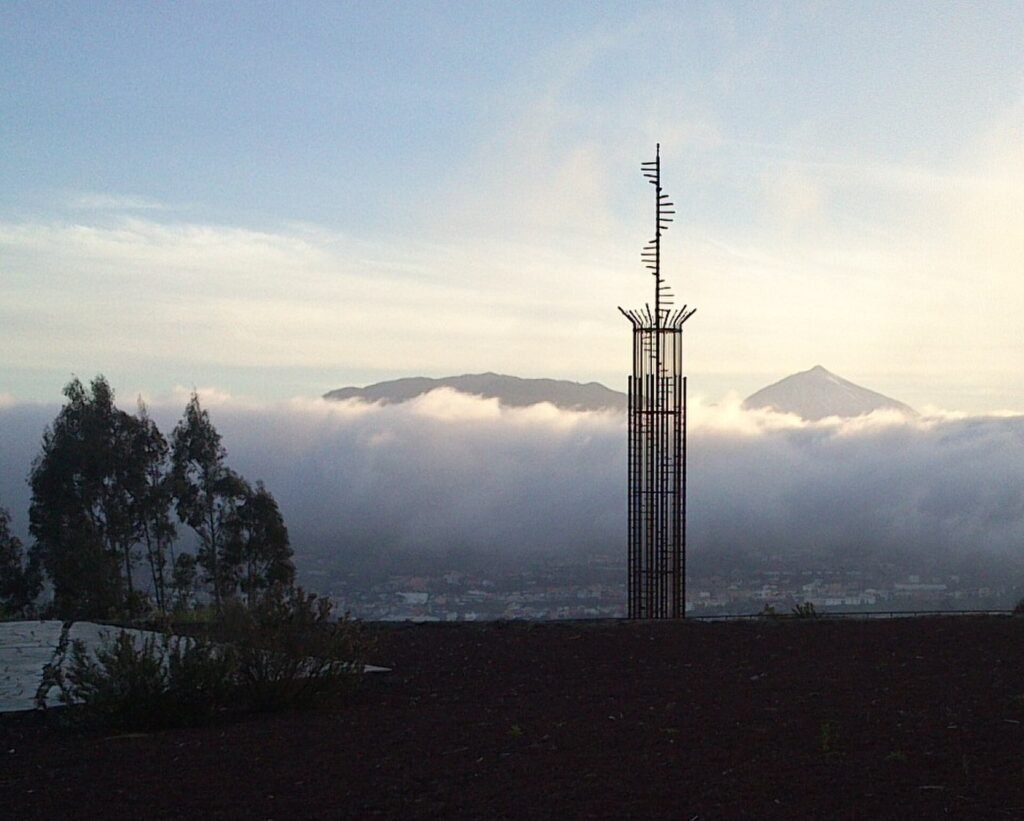
Note: no footage of the collision itself exists. Airport footage in the film is modern and used as setting only.
Sources and credits
- Wikipedia — Tenerife airport disaster: https://en.wikipedia.org/wiki/Tenerife_airport_disaster
- Encyclopaedia Britannica — Tenerife airport disaster: https://www.britannica.com/event/Tenerife-airport-disaster
- FAA Lessons Learned — Boeing 747-206B and Boeing 747-121: https://www.faa.gov/lessons_learned/transport_airplane/accidents/PH-BUF
- AeroCorner — Tenerife 1977: https://aerocorner.com/blog/tenerife-1977/
- Investigation: Spain’s Civil Aviation Accident and Incident Investigation Commission (CIAIAC), official report 16 November 1978.
- Photo credits: KLM PH-BUF photo CC BY-SA 2.0 by clipperarctic; Pan Am N736PA photo CC BY 2.0 by Rob Russell; runway diagram recreated from the diagram by Mtcv (CC BY-SA 3.0); wreckage photos Dutch National Archive (Anefo), CC0, via Wikimedia Commons; International Tenerife Memorial photo CC0 by Jesús Manuel Pérez Triana.